
We arrive at choir rehearsals, often at the end of a long day and with all the day’s concerns and problems whirling in our heads. Many of us know just how refreshing and re-energising it is to immerse yourself in singing – it’s why we come to choir and turn out on dark evenings, even when we’re at a low ebb.
To help channel your inner-energy, increase your enjoyment, avoid vocal, eye, neck or any other sort of strain – and generally get the most out of your evening – there are a few things I would suggest considering:
Start the warm up process before choir
The second you leave the house, drop your shoulders and try to lower your breathing so you are breathing more slowly into the back and lowest part of your lungs. Allow your chest to relax so that all your breathing is happening to your sides and back.
If you have a few minutes in the privacy of your car, hum and then lip trill (or roll r’s) along to an easy song. These ‘semi-occluded vocal tract’ exercises help ease your voice into singing, smoothing the transition from spoken to sung sound. Doing these exercises before rehearsal will add to the warm up you do in choir
Be aware of your body’s needs
It’s absolutely ok to stand up if you’ve been sitting down all day (stretch out as and when necessary) or sit down and take the strain off your feet if you’ve been standing, or even take a breather for some fresh air. It’s your rehearsal and you know what you need to do to get the most out of it.
Nourish and hydrate yourself

It almost goes without saying, but then, it’s so easy to forget to look after ourselves! Eating early is good. Hydrating early is essential. If you arrive at choir feeling thirsty, you are already dehydrated. So try to sip water throughout the day and especially three hours before a rehearsal. Don’t worry about remembering a water bottle, simply grab a glass of water in rehearsal whenever you need it – it’s one thing less to carry around!
Don’t overstretch or strain your voice
If you’re keen to extend your vocal range you can certainly do this, but over a number of sessions and with regular practice. Don’t try to overreach in any single rehearsal. Work with the vocal techniques you learn and don’t be tempted to short-circuit the process. Straining for notes above your current range or belting out a fortissimo passage by using your throat will help nothing in the long run, and in the short term will damage your voice for the rest of the rehearsal and possibly the next day too! Equally, do try out the techniques you are learning in rehearsal without worrying if something comes out in a strange way. That’s what rehearsals are for. But gently and kindly does it!
Listen for any strain in your sound
Are the notes you are singing mellow, fluid and rounded in tone? Or can you hear a sharp/raucous edge to them or breathiness? If the latter, stop for a moment and recalibrate. Have a sip of water, massage your cheeks, take some low, relaxed breaths. Smile and try to imagine yourself laughing heartily through your whole body. Then rejoin!
Think about how you hold your music – or take a risk and don’t hold it at all!
Bending your neck over a heavy folder or a sheet of faintly printed or small music is an unnecessary strain. In rehearsal, only ever hold one copy of music at a time – not your whole folder – but it is really helpful to hold it in a light cardboard folder so it doesn’t flap all over the place and you can stand well.
Pencil in large cue words as you work on a piece so that you only need to glance down to see a prompt for a phrase, not peer at the small print. Better still, use a scanned and enlarged copy of the original and mark it up with large cue words and reminders in red ink (there is some research to show that we compute red more quickly, and I tend to feel this is true).
You might like to use a music stand in rehearsals, so that you are hands free or better still, put your music away at the earliest opportunity and continue to practise without it.
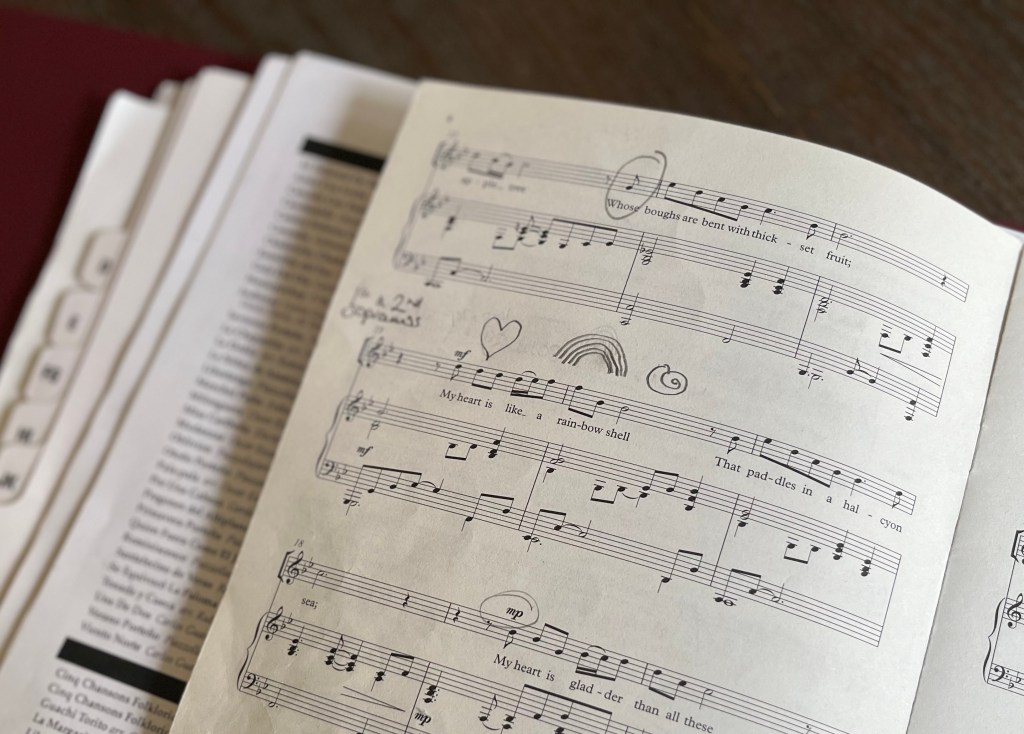
I even sketch in visual clues to the lyrics where I can, as this is faster to read than words – especially for phrases where I have a mental block, such as this one! Then remind yourself to stand well, with your neck straight and use only your eyes to glance down at your ‘cue-ed up’ music.
Try preparing your music like a ballet dancer prepares her pointe shoes
Maybe not everyone feels like this, but I enjoy working from my music so much more if I prepare it and customise it with my personal notes. Obviously, leading various different choirs means I need to do this to a greater degree than individual singers, but there is a joy in having neatly marked up music with your own notes and prompts, little coloured flags if you need to flick between dal segno or a coda markings, reminders at the bottom of each page of the next words and dynamics – so you don’t turn a page and realise you should have dropped to pianissimo.
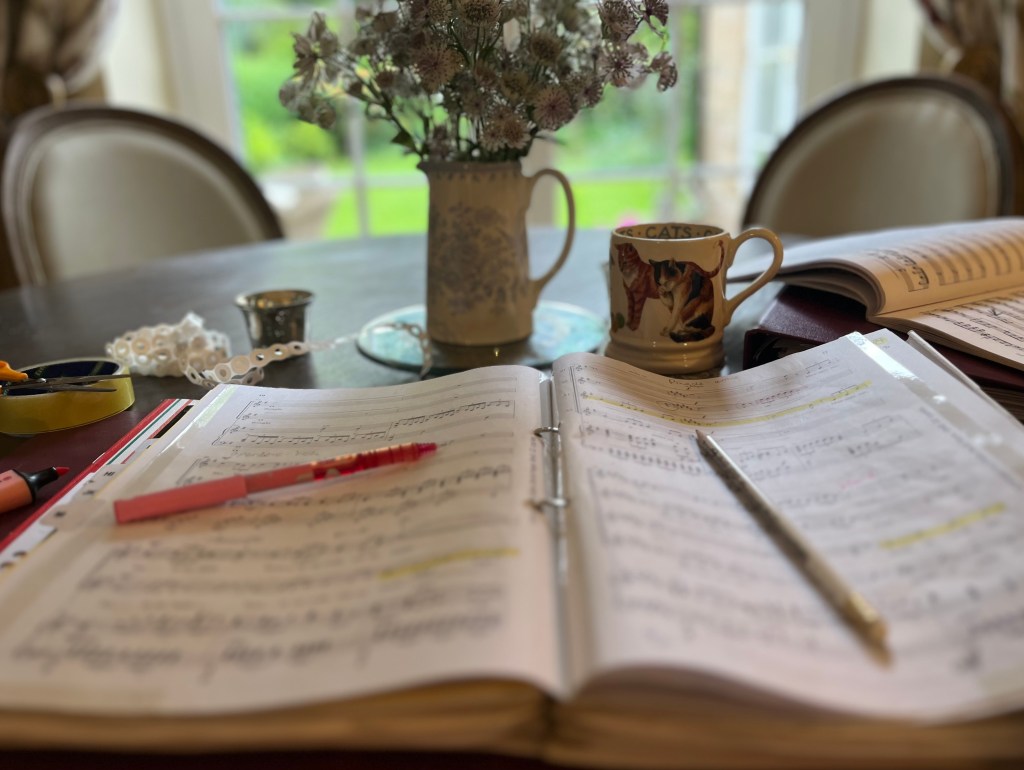
I even sellotape page edges and corners to help flick tricky page turns more quickly. Its similar to the mindful way in which ballet dancers prep their pointe shoes and I find this sort of methodical activity quite therapeutic, especially early morning, sitting at my dining room table with a cup of tea. Yes it’s a bit obsessive, but if this is your personality type too … have a go! It might make your rehearsals feel more satisfying and relaxed.
A musical filing system
For those who love organisation, ditto the remarks above!
Take in the whole choir experience
Listen. Enjoy the blend of sounds around you. Step out from focusing solely on your own notes/line and vocal part and appreciate how the music is developing and sounds coalescing across the whole choir.
Don’t stress if you’re too tired – take a recording
It’s ok to use your phone to record any part of the rehearsal you want, then you can listen again in the bath or on your commute to work during the week. If you’re particularly tired this is a great way to relax and not worry about missing some of the detail everyone is working on.
Indulge in après-choir social time

Unless you have an early start or long drive the next morning, a quick drink with everyone after choir is so enjoyable, and I miss it on the occasions that I can’t go. It is as much a part of the choir experience as the singing itself. The friendship, camaraderie and support among what we all call ‘our choir family’, is second to none. It relaxes you on another level so you sleep better after a rehearsal and I’m convinced, creates more synergy when we come together again to sing!
 belcantobaslow.uk
Leave a comment